
How Automation is Shaping the Future of Cloud Security
In the modern landscape, cloud security has become a pillar for businesses that rely on cloud computing as the cloud computing infrastructure for the safety of sensitive data, and security remains the top priority of companies as the cloud continues to evolve, and automation in the cloud has emerged as a game-changer, as businesses need to stay ahead of threats. Cloud security automation is transforming businesses in cloud environments, as the threats and the complexity of infrastructure make it hard for businesses to focus on every department; therefore, automation is required to ensure cloud security in a scalable environment.
Growing Complexity of Cloud Security
Cloud environments are complex, as are the data, applications, and services found in public, private, and hybrid clouds. As the complexity can create threats that need to be mitigated at all levels, traditional manual security practices, such as firewalls and on-demand, are insufficient in the fast-paced cloud landscape. Cloud environments scale, and businesses need real-time security that is quick, proactive, and effective. The automation addresses the challenge by providing AI-powered security tools that offer continuous protection.
8 Steps For Successful Cloud Security Automation
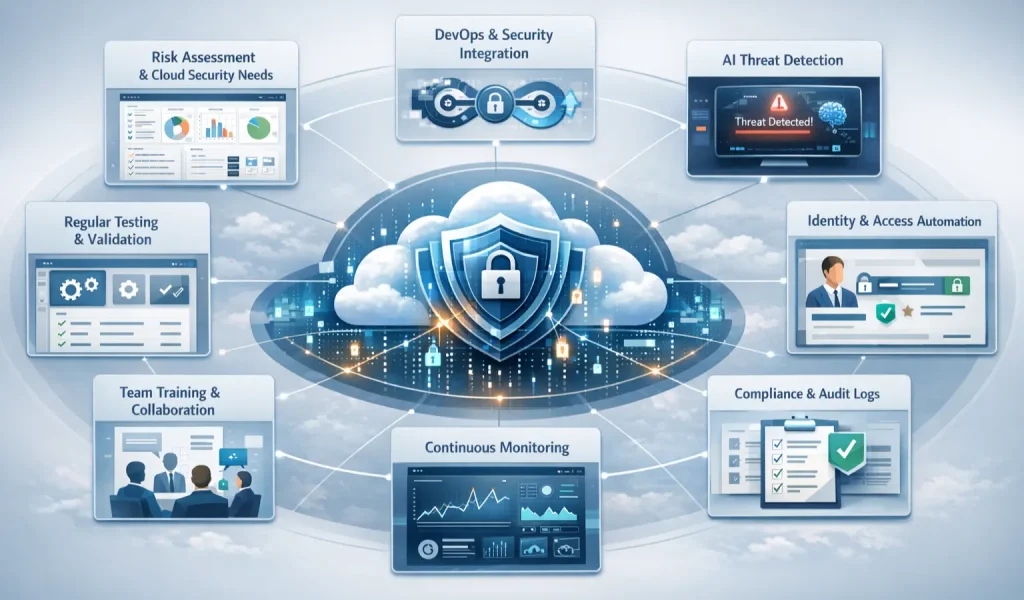
1. Assess The Cloud Security Needs
Evaluating the organization’s security requirements, vulnerabilities, and goals as a step will help in the approach, ensuring maximum efficiency.
2. Integrating Security
Embedding security practices into development and operational workflows as a step enables the detection and mitigation of vulnerabilities throughout the development cycle.
3. Implement Automated Threat Detection
The monitoring tools use Artificial Intelligence (AI) and Machine Learning (ML) algorithms to detect and mitigate suspicious activities in real time.
4. Automate Identity Management
The management of user roles, including access permissions and processes, with automated controls to ensure no unauthorized access.
5. Maintaining the Compliance and Logging
For automating compliance checks and logging into mechanisms to ensure adherence to safety standards.
6. Monitor and Audit
For deploying tools that provide continuous monitoring and generate reports to track the performance of security systems.
7. Educate Teams
For developing automated workflows for handling a security incident and updating the security books. Conducting employee training using automated cloud security tools will foster collaboration among security, IT, and development teams.
8. Test Regularly
The cloud security automation doesn’t end there; it must be tested to identify any gaps or inefficiencies for refinement and full security.
Benefits of Automating Cloud Security
The cloud security automation offers organizations a strong security posture that encapsulates threat detection, response development, and policy as the cloud environments grow in complexity and automation provides the key aspect against emerging threats, providing a proactive defense strategy. The benefits include proactive threat management, enabling continuous monitoring and real-time responses that reduce the risk of external attacks and damage.
Organizations are becoming more agile based on their needs and understanding, as the business landscape is constantly evolving, and they need automation to scale seamlessly with growth. The security tools enable and empower organizations to adapt quickly to new threats, maintain a strong defense, and address human errors that can lead to vulnerabilities in security configurations. The processes ensure consistent application of the policies across the organization. The compliance standards and the automation help meet the requirements.
How Automating Cloud Security Enhances Your Business Capabilities
Customers need comprehensive, continuous security validation, and the risk exposure is too high, as businesses can feel threatened by malicious activities in the cloud environment. The fully automated cloud security system ensures smooth management and prevents external attacks. As the security controls across layers, including applications and infrastructure, are necessary to keep organizations prepared for vulnerabilities. Automation is no longer a trend; it is a vital tool that ensures cloud environments are secure and scalable. As the future of cloud solutions plays a pivotal role in enabling businesses to ensure the safety of their digital assets and future-proof their operations.